How Joinery AI is solving everyday business problems
How Joinery AI is solving everyday business problems

Erin Woodger of Joinery AI discusses three problems he sees in almost every joinery business, and how they’re being solved.
Over the past few years, we’ve worked alongside joinery manufacturers of all shapes and sizes, small family firms, growing teams, and multi-site operations.
Different regions. Different specialisms. Different markets.
Yet the same three problems come up again and again. They’re rarely talked about openly. Most owners just accept them as “part of the job”. But they don’t have to be.
1) “We’ve tried systems before. They never really stuck.”
We hear this constantly. One director we spoke to had invested in three different software packages over five years. None of them were fully used.
Each time, the story was similar: The system looked promising, There was genuine intention to set it up properly, Then day-to-day pressures took over. Quotes needed doing. Problems needed solving. Staff needed support. And there simply wasn’t the time or headspace to configure another piece of software and keep it running.
Often, it’s not one system, it’s a patchwork: One handles accounts, Another does quotes, A third tracks jobs. They don’t speak to each other properly. Setup drags on for months. Training never quite finishes. And quietly, people drift back to spreadsheets and email folders. Eventually, the systems are still there… but the business isn’t really running on them.
What made the difference with JoineryAI was simplicity.
Instead of trying to replace everything at once, it connects the things joinery businesses already rely on: enquiries, emails, quotes, jobs, and production schedules.
Information flows automatically. No one has to “maintain” the system. As one manager put it: “It just fits around how we already work.” When systems stop feeling like extra work, people start using them.
2) “We don’t really know how profitable we are, until it’s too late.”
Most owners can tell you roughly how things are going. Very few can show you accurate, up-to-date figures mid-year.
Costs are scattered across invoices, timesheets, spreadsheets, and accounting software. Work in progress is estimated. Overheads are hard to allocate. Job margins get reviewed months after completion, if at all.
In one business, the director was shocked to discover that several “good” jobs had barely broken even once labour and rework were included.
With JoineryAI, every job is costed from the start. Labour hours are tracked against estimates, Materials and subcontracting are linked , Work in progress is visible, Invoicing and costs align
For the first time, management accounts matched reality. The result isn’t just better reporting, it’s better decision-making. Quotes improve. Pricing becomes more consistent. Loss-making work gets spotted early.
3) “Nothing moves unless I’m in the workshop.”
This one is painfully familiar. When the owner is on the shop floor, things run well. When they’re quoting, meeting clients, or dealing with admin, progress slows. Jobs wait. Priorities get unclear. Bottlenecks appear. Everyone works hard, but not always on the right thing.
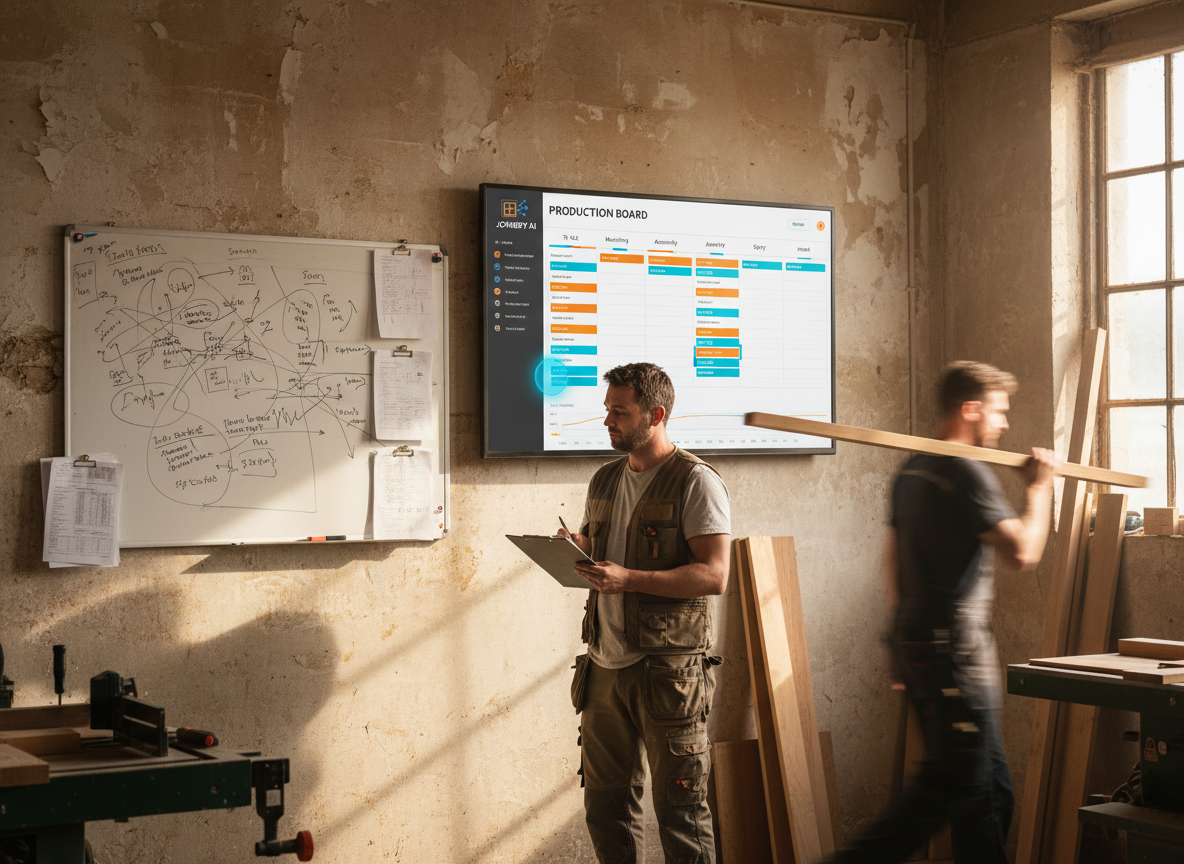
In one case, the production schedule lived on a whiteboard and was updated irregularly. Only one person really understood it.
JoineryAI introduced structured production planning. Each job had planned hours, delivery targets, and priorities. Teams could see what was coming next. Managers could see where time was being lost.
It removed the need for constant chasing. Just as importantly, completed jobs fed back into costing, improving future estimates without extra admin.
What this has led to
Following the successful initial launch of JoineryAI, more businesses have approached us with the same aims.
In March, a new group of joinery companies will begin using the platform. Each of them is looking for: A system that works and that everyone actually uses , Clear, reliable numbers they can trust – A better understanding of how to grow profit A production plan that runs whether the owner is in the workshop or on the beach
For many, the goal isn’t to work harder. It’s to build a business that functions properly without constant personal intervention.
A pattern across the sector
Individually, none of these problems are unusual. Together, they create pressure: Long hours, Uncertain margins, Constant firefighting, Limited time to think strategically
What these case studies show is that many of these issues aren’t about effort or skill. They’re about systems. When information is connected, reliable, and visible, businesses run differently. For many firms, the biggest change hasn’t been technological. It’s been clarity.
Find out more
JoineryAI is now opening its next intake to new businesses.
The first 100 clients will receive: White-glove onboarding at no cost – 60% off the standard monthly fee for life – A fixed price of £250 per month (that’s £8.22 per day)
For roughly the price of two coffees, you gain the potential to: Get your time back, Improve your cashflow and margins, Reduce day-to-day stress, Build a business that runs without constant firefighting
You can also start with a 14-day free trial.
To learn more, visit: www.joineryai.app
More news

TJN Members Day puts timber’s future in focus

Shortlist for 18th BWF Awards revealed