AI comes of age at PWE 2026
AI comes of age at PWE 2026
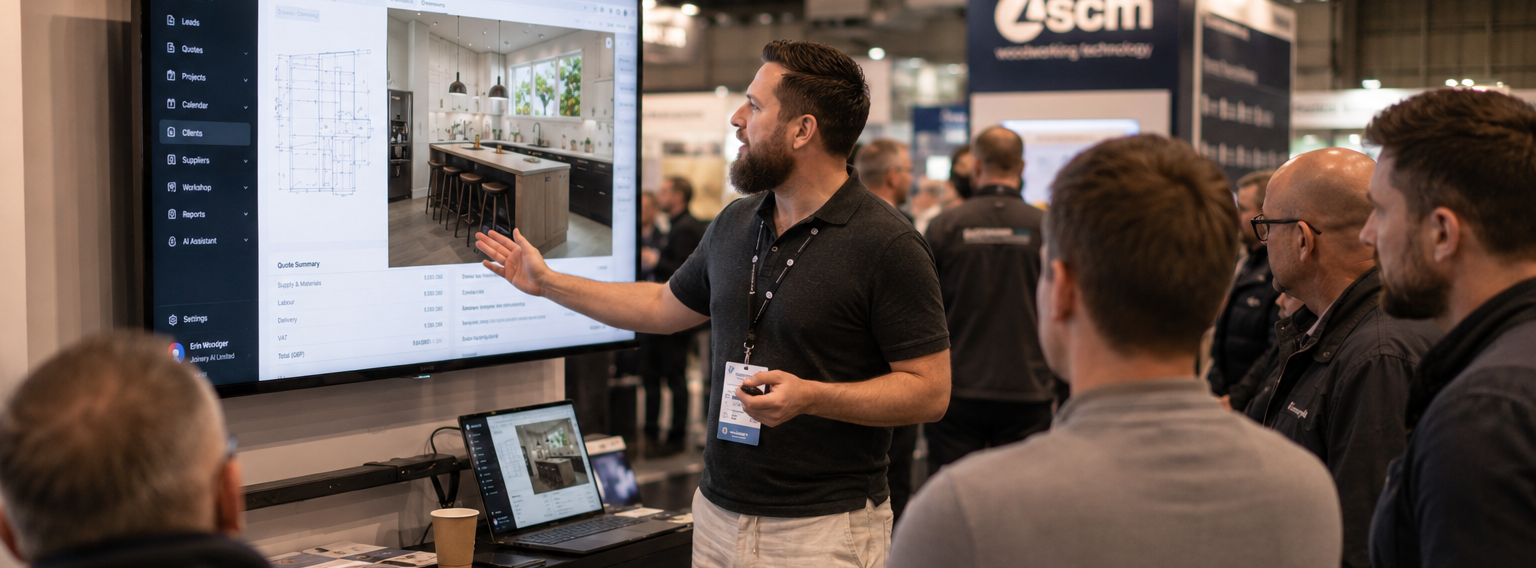
Erin Woodger, Founder of JoineryAI, explains how there was great interest in Artificial Intelligence (AI) from visitors to this year’s Professional Woodworking Expo (PWE), and what it can do bring to the joinery sector.
Artificial Intelligence (AI) has dominated headlines for the past two years, but for many joinery businesses it has remained something of an unknown quantity.
While plenty of owners have experimented with tools such as ChatGPT, a common question remains: How does this actually help me run my business?
That question appeared to be answered repeatedly at this year’s Professional Woodworking Expo (PWE).
Across the exhibition, the greatest interest wasn’t in AI’s technical capabilities but in its practical application.
Visitors responded most positively to demonstrations showing familiar, everyday workflows being completed in seconds rather than hours.
Seeing a photograph of a customer’s home transformed into a realistic visualisation of a new entrance door, accompanied by an estimated price, helped many visitors understand how AI can enhance the customer journey while dramatically reducing the time spent producing quotations.
Perhaps more telling were the conversations taking place away from the exhibition stands.
Manufacturers, installers and business owners consistently highlighted the same pressures.
Skilled labour remains difficult to recruit, office staff are stretched, and administrative tasks continue to consume valuable time.
Chasing enquiries, preparing quotations, following up prospects and processing orders are all essential activities, yet they rarely generate value in the way that designing, manufacturing or installing quality joinery does.
Increasingly, businesses are beginning to view AI as a digital member of the office team rather than a replacement for experienced people.
By taking responsibility for repetitive administration, AI allows skilled staff to concentrate on the work that genuinely requires human judgement, technical expertise and customer relationships.
This shift in thinking feels significant.
Only a year ago, discussions around AI were dominated by concerns about what the technology might replace.
Today, the conversation is becoming far more pragmatic. Joinery businesses are asking where AI can remove bottlenecks, improve responsiveness and increase capacity without the need to recruit additional staff.
The technology itself will continue to evolve rapidly, but its success within the joinery sector is likely to depend less on headline-grabbing innovation and more on solving the industry’s everyday challenges.
Faster quotations, streamlined administration, integrated product data and better customer communication may not attract the same attention as the latest AI model, but they are precisely the improvements that can have the biggest impact on profitability.
If this year’s Professional Woodworking Expo demonstrated anything, it is that AI has moved beyond novelty.
For many joinery businesses, it is becoming another workshop tool—one designed not to replace craftsmanship, but to give skilled people more time to practise it.
For more information about JoineryAI and how it can help your business, visit: JoineryAI: One Place for Everything Your Joinery Business Runs On.
More news

TJN Members Day puts timber’s future in focus

Shortlist for 18th BWF Awards revealed